Alain Badiou is one of the most inventive and compelling French philosophers. He visited Belgrade on multiple occasions where he gave lectures and interviews. In the videos below, Alain Badiou discusses the four procedures of truth. As exposed in his book The True Life directed at today’s youth, he considers that true life is: “A life that does not limit itself either to obedience or the satisfaction of immediate impulses. A life in which the subject constitutes herself as a subject. For me there are four domains in which truth manifests itself, what I call the four procedures for the construction of truth: art, love, politics and science. My wish for the youth is that they traverse these four conditions: to encounter art in all its forms; to be loving in fidelity, and for a long time; and to participate in the political reconstruction of a world of justice, as against the world such as it is. And not to be as ignorant of science as they currently are, so that they do not leave it in the hands of technology or capital.”
Songs We Sang Before the Future

In summer 1962, the 8th World Festival of Youth and Students took place in Helsinki, bringing together more than fifteen thousand people from all around the world engaged with the struggle for peace and in solidarity with global liberation movements. Openly aligning with the socialist bloc, the festival happened during the most antagonistic period of the Cold War; with the mass movements of African decolonisation, the height of military bullying between superpowers, and the Sino-Soviet split. The summer of 1962 in Helsinki was a boiling point and the condensation of the principal contradictions of the Cold War. This publication opposes conceptual simplifications when dealing with the global political forces unfolding into cultural and artistic manifestations. These artistic mani fes-tations were broadly present during the festival and they expressed the need for envisioning new languages and a new world. The festival happened during an international momentwhen politics, especially for the militant youth, meant some-thing else than the mere representation of the party or state interests. The best way to picture this specificity is to look at one particular event within the festival that spoils the usual Cold War narrative. Presumptions remain subscribed to the main stream consensus that jazz played an important role in defending freedom outside of Western liberal capitalism.
With this book, we are giving a voice to a different sixties unburdened by Cold War ideology based on aggressive administration and bullying politics. By making a case for the act of free jazz musicians performing in the socialist festival, we intend to distort the liberal picture of the sixties. The testimonies we are reproducing and the concepts we are developing are evidence of the collective spirit of true international solidarity. What happened massively on the global conjuncture was happening locally on a smaller scale in Helsinki: the festival dedicated to peace was opposed with the counter-festival, dubbed as Young America Presents, secretly financed by the CIA as well as local conservative and anti-communist political actors.

In Sound Alignments, a transnational group of scholars explores the myriad forms of popular music that circulated across Asia during the Cold War. From studies of how popular musical styles from the Americas and Europe were adapted to meet local exigencies to how socialist-bloc and nonaligned Cold War organizations facilitated the circulation of popular music throughout the region, the contributors outline how music forged and challenged alliances, revolutions, and countercultures.
It was the movie Most (The Bridge, 1969) by Yugoslavian director Hajrudin Krvavac that first served as the conduit for the crossover of “Bella ciao” to China. Along with Valter Brani Sarajevo (Walter Defends Sarajevo, 1972), also directed by Krvavac, The Bridge was one of the most popular films in late-1970s China. “A peng you zaijian,” which literally translates as “Goodbye, friend,” is the Chinese version of “Bella ciao,” widely considered the most famous song of the Italian resistance movement during World War II. It is a fascinating example of a song that traveled in different guises through many routes. It is often sung with clapping, for instance, but in the Chinese version, the clapping is verbalized with the syllable “ba” following “peng you zaijian” in the refrain. Tracing “Bella ciao” back in time, one does not find any definite point of origin. In the words of a historian who interviewed Italian partisans on their musical memories of World War II, “the history of ‘Bella ciao’ is like a novel without an ending, because there is no unique text but several variants that underwent many transformations and interweave with multiple individual and collective stories.” A hybrid vehicle of diverse sonic and textual materials ranging from rice field labor songs to children’s games, it has been translated into thirty languages and continues to be adapted by many protest movements to this day.
In fact, in spite of the widely held assumption that “Bella ciao” was sung by all partisans, during the war its diffusion was limited to central Italy in 1944–45. The brigades fighting in the north mostly sang “Fischia il vento” (The wind whistles), which was based on the melody of the Russian “Katyusha” and whose text included such lyrics as “the sun of tomorrow” and “red flag” that directly referred to socialism. In the early 1960s, “Bella ciao” was retrospectively chosen as the hymn of the resistance because it was a more inclusive song that “focused not on any particular army or brigade, but on a single man, a martyr of that continental tragedy that was Nazi fascism.” Moreover, its growing international fame and dissemination through the media also contributed to its canonization. When “Bella ciao” was performed by a choir of former partisans from Emilia Romagna at the World Festival of Youth and Students in Prague in 1947, in Budapest in 1949, and in Berlin in 1951, thousands of delegates from seventy countries joined in clapping hands and sang along. The Italian Young Pioneers Association, a leftist youth organization for children up to fifteen years old, sang it at their camps and at international youth gatherings. It was sung in both Italian and Russian by Muslim Magomaev, a famous Azerbaijani singer dubbed the “Soviet Sinatra,” starting in 1964. In the same year, two differently worded versions, the first originating among rice field workers in northwestern Italy and the second dating back to partisans, were included in the concert “Bella ciao” at the Seventh Festival of Two Worlds in Spoleto (Italy), a controversial event that brought folk songs to the national stage and was broadcast on television. Yves Montand’s interpretation in 1963 greatly contributed to its fame, paving the way for more recent versions, including those by Manu Chao, Goran Bregovic, and Marc Ribot and Tom Waits.
Ivana Bago: Yugoslav Fanonism in Three (Exhibitionary) Acts: 1950/1972/1989

In March 1950, Pallais de Chaillot in Paris, the home of the National Museum of French Monuments, became the site of the exhibition L’art médiéval yougoslave, the first large-scale official presentation of Yugoslav art in the West after WWII. Under the guidance of writer Miroslav Krleža (1893–1891), the project evolved from a small-scale presentation of Serbian and Macedonian medieval frescoes into polemical revelation of the lost “South Slavic civilization” and an assertion of Yugoslavia’s place in world history following its 1948 expulsion from the Cominform. The lecture will consider this exhibition as the prime case of Yugoslav Fanonism, a declaration of Yugoslav cultural and political autonomy vis-à-vis both the East and the West, which heralded Yugoslavia’s position in the Non-Aligned Movement in the following decade. Two other exhibitions – a conceptual curatorial intervention Postal Packages (Zagreb, 1972) and a pan-Yugoslav gathering of artists under the name Yugoslav Documenta (Sarajevo, 1989) – will be revealed as evidence of the persistence of such Yugo-Fanonist declarations, even in the radically altered historical conjunctures of the 1970s and the1980s. Together, the three exhibitions form a kind of dialectical triangle, a thesis, a negation, and a (failed) synthesis, illuminating the key points of Yugoslav historical destiny.
A Museum in Exile: Solidarity with the People of Palestine

The International Art Exhibition in Solidarity with Palestine was inaugurated in Beirut (Lebanon), March 1978, and was intended as the seed collection for a museum-in-exile. Inspired by the Museum of Resistance in Exile in Solidarity with Salvador Allende, the deposed Chilean president, the collection took the form of a traveling exhibition that was meant to tour until it could “repatriate” to historic Palestine. Organized by the Palestine Liberation Organization (PLO), comprising almost 200 works donated by 200 artists from nearly 30 countries, the exhibition remains one of the most ambitious, in scale and scope, to have ever been showcased in the Arab world until this day. Tragically, during the Israeli siege of Beirut in 1982, sustained shelling destroyed the building where many of the works were stored as well as the exhibition’s archival and documentary traces.
 Loading…

 Reload document
  Open in new tab
 Source: http://learnpalestine.politics.ox.ac.uk/uploads/sources/588da8858e641.pdf
Border Crossings North and South Korean Art
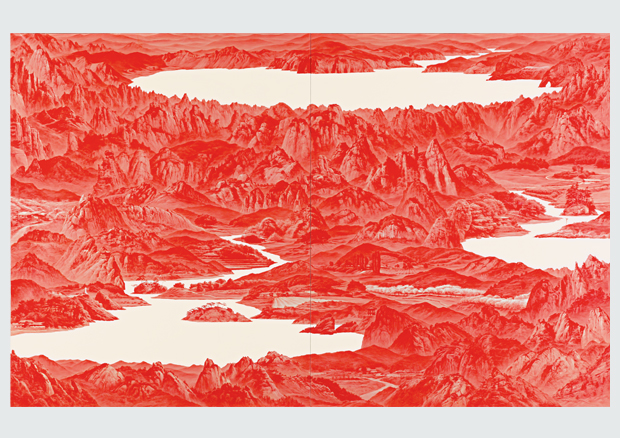
Kunst Museum Bern 30.04.2021 – 05.09.2021
The title of the new exhibition, “Border Crossings”, reflects the fact that the Korean border is a prohibited zone for Korean citizens from both sides. Crossing this border means making a long detour, usually via China – or, in this case, via Bern.
The exhibition allows the public a close look at the Korean Peninsula, divided since 1953. A 250-kilometre border of barbed-wire fences and anti-tank barriers divides Korea into two states which could not be more different from one another. Equally divergent is the art produced simultaneously in the two countries.
What makes the Korean situation special from an art-historical perspective is the concurrent existence of the vital contemporary art scene in South Korea and an undiminished cultivation of the tradition of socialist-realist painting in North Korea. Diametrically opposed artistic attitudes are able to coexist, reflecting the irreconcilability of the political systems and striking differences in the two populations‘ way of life.
The Working Class Is Off To Paradise (For May 1st)
The story takes us into the everyday lives of five former employees of the industrial giants in Zrenjanin, Serbia. Created in the form of a documentary drama the film gives a fresh insight into the fates of the forgotten heroes of the working class – people, who have overcome time, the system, the transition and poverty, and whose tragic life stories are new, modern, authentic and lasting.


Spanish edition of The Communist Manifesto, artist Fernando Vicente
Yugoslav architect Svetlana Kana Radević is saluted at the Venice Architecture Biennale

Kana on the Montenegrin coast, above Jaz – personal archive
“Svetlana Kana Radević, a socialist Yugoslav architect who effortlessly moved between and drew influence from Philadelphia, Tokyo, and the Montenegrin capital city of Podgorica over the course of her celebrated career is the subject of a comprehensive exhibition opening May 22 at the Palazzo Palumbo Fossati as one of 17 collateral events at the 17th Venice Architecture Biennale.”
https://www.archpaper.com/2021/04/yugoslav-architect-svetlana-kana-radevic-is-saluted-at-the-venice-architecture-biennale/
https://kanaradevic.me/biography/


Dissent of Zenitism – A Tribute
Artistic, Programmatic, Aesthetic, Political and Existential Critique of the World


The journal Zenit (Zenith) was a Yugoslav avant-garde review of new art and culture, initiated in 1921 by the poet and critic Ljubomir Micić. Until 1923, it was published in Zagreb, and subsequently in Belgrade. Zenit was sharply criticised, prohibited even, and accused of being Bolshevik propaganda agitating for social revolution. In 1926 after forty-three issues, the review was proscribed by the authorities.
During its relatively brief and controversial history, Zenit sought to convert negation into affirmation, to introduce experimental artistic creation, and to exploit all forms of contradiction and antinomies – described by Micić as “abstract metacosmic expressionism.” All of his ideas were summarized in the manifesto centred on the figure of the Balkanic/Slavic barbarogenius who defies the decadence of Western Europe. Its use of the term ‘revolutionary’, and antibourgeois, antitraditional, anticlerical, and antiacademic stance were the means by which Zenitism demanded total change in art and the world. This revolt against traditional middle-class values and their restrictive cultural and social criteria was a feature it shared with the European avant-garde. Zenit attempted to articulate a program that would lead to the formation of a movement with distinctly sociopolitical implications. By publishing articles in their original languages – Russian, German, French, English, Hungarian, Flemish, Italian, Czech, Bulgarian and Esperanto – Zenit was operating in an international context as a recognised member of the European reviews that promoted the idea of “Zenitism as a Balkan totalizer” of a new life and new art.

“Europe can only be born again, fertilized by raw power and new seeds, and certainly not be reborn itself from itself. […] Balkanization of Europe, in brief, means: the formation of a new type of culture and man with the stamp of Balkan ethics and Balkan direct humanity – which still means: creating a culture of life and not a culture of lies and paper – creating new life and in that life a new culture for all and not for the privileged, not for libraries, galleries and museums. […] Barbarogenije is a carrier of no sentiment, but of raw vitality – pure faith – unadulterated soul – with an open and good heart, which is full of all-human love, we and Russians introduce into the new life of the new humanity.” Ljubomir Micić – Zenit. no. 21. (Feb. 1923)
All issue of Zenit can be found here
Walking on Thorns – Thoughts on the Art World Today

As consumers, capitalism grooms us to live in the present. Contemporary electoral politics — especially as practiced in the United States — and contemporary twenty-four-hour news media also try and trap our imagination in the present. The past and future, history and long-term imagination, are all obliterated or obscured — crushed by short-term thinking. William Gibson has begun calling the combined onslaught of catastrophes — ecological, pathogenic, military, economic, etc. — that will come raining down in the twenty-first century “The Jackpot” — a slot-machine future that comes up all skulls. Once you see the growing world crisis gathering momentum around us, it’s hard to avoid asking where today’s conditions lead. Boomers may only have a few years left among us, but the generation entering adulthood now will see most of the century. For people who have a strong chance of being here mid-century, this is personal. As an artist, I’m equally as interested in describing and depicting our own era as I am in speculating about where it might lead. I’m not fixated on realism. My work is firmly situated across the border in the world of fiction. Grappling with how people in the future will view our present when it becomes their past is a very useful exercise — especially for Americans. The present moment will end and become something else.
Josh Kline – https://flash—art.com/2020/10/conversation-with-josh-kline/
§
Possibly for the first time since the fall of the Berlin wall, there is serious global debate on why and how neoliberalism has failed us, and on what alternatives lay ahead. What we have learned beyond doubt form the present crisis is that the neoliberal rule amounts to power without responsibility: if there is a shipwreck, the commander uses his/her privilege to step down first, not last, from the sinking boat. And that the safe spaces of the happy few are guaranteed, and eventually paid by, the personal risk and sacrifice of the most vulnerable and marginal. This is not just what happens in the outside world, though. The safe space of the art institution itself, again, is not equally safe for everybody working in it, as eloquently shown by the massive layoffs of museum professionals and workers, instantly deployed even by museums with huge financial endowments for which no concrete issue of financial meltdown was at stake. This opens up a dilemma: can art really keep on reasoning in terms of safe spaces in times like these? Can it afford to dwell on issues of social injustice, violence and abuse without taking any commitment or responsibility toward the victims? Can art institutions maintain their social credibility when they mechanically apply to their own employees the same brutal neoliberal logic they customarily attack when it comes to the practices and choices of the political or corporate world? The social relevance and credibility of contemporary art institutions today eventually relies upon their capacity to transform themselves from safe spaces for privileged minorities to inclusive spaces. But what does this mean in practice? For instance, it means escaping from what one could call the philanthropy trap. In many circles, arts patronage is an exquisite form of philanthropy that pays well in terms of promotion of social image, savvy fiscal management and sophisticated lobbying. Before the crisis, global competition among major contemporary art museums worldwide increasingly looked like a global arms race, where securing the latest, biggest productions from blue chip names was the only way to stay on the cutting edge. In this context, falling into the philanthropy trap is not an option, it is a necessity if one wants to stay in the race. The consequence is that any kind of social critique taken from such a position of complacency toward big donors sounds completely groundless, paves the way to innumerable conflicts of interest, and reinforces the conviction that, at the end of the day, art and its institutions are basically the objective correlative of privilege. Moving toward inclusion does not mean inviting more people into the club for a quick sneak peek, to offer them a unique opportunity of illumination. It rather means changing the hierarchy of the priorities, and putting social relevance and responsibility at the top.
Pier Luigi Sacco – https://flash—art.com/2020/11/circling-the-square-art-and-inequality-taken-seriously/

Unlike the formal economy, this missing mass or dark matter consists of informal systems of exchange, cooperative networks; communal leisure practices; conduits for sharing gossip, fantasy anger, and resentments; and even the occasional self-organized collective that may or not be politically motivated. Within this dark universe, services, goods, information, and in some cases outright contraband are duplicated and distributed, sometimes in the form of bartered exchange and occasionally as gifts that circulate freely, thus always moving and benefiting a particular network or informally defined community. All of this is disconnected, or only partially connected, from the mainstream market. For capitalism to acknowledge this missing mass would require a radical re-definition of the concept of productivity.
Gregory Sholette – ‘Swampwalls Dark Matter & The Lumpen Army of Art’, Proximity, no 1
§
No public image should benefit from impunity, for whatever reason: alogo belongs to public space, since it exists in the streets and appears on
Nicolas Bourriaud – Postproduction
the objects we use. A legal battle is underway that places artists at the forefront: no sign must remain inert, no image must remain untouchable.Art represents a counter-power. Not that the task of artists consists in denouncing, mobilizing or protesting: all art is engaged, whatever its nature and goals. Today there is a quarrel over representation that sets art and the official image of reality against each other.
§
Our power of resistance and invention requires that we renounce our delights in the margins, in obliqueness, in infinite deconstruction, in the fragment, in the trembling exposition of mortality, in finitude, and the body. For the sake of the poor century which is opening, we must, and thus we will, declare the existence of what no longer exists in art: the monumental construction, the project, the creative force of the weak, the destruction of established powers.
We should oppose all those who only want the end, those cohorts of the burned-out and parasitical last men. The end of art, of metaphysics, of representation, of imitation, of transcendence, of the oeuvre, of spirit: enough! Let us declare at once the End of all the ends and the possible beginning of all that is, of all that was and will be.
Against its present decline into inconsistent multiplicity and an energy which is immoral, uncontrolled, and-if it succeeds-fundamentally non-human, the vocation of art, in all its forms, is to reaffirm affirmation.
Let us declare again, on behalf of humanity, the artistic rights of the truly non-human. Let us again accept being transfixed by a truth (or a beauty: it’s the same thing), rather than calculating to the nearest penny the minor modes of our expression.
It’s a matter of affirming. And this is why this draft is a manifesto of Affirmationism.
Alain Badiou – ‘Third Sketch of a Manifesto of Affirmationist Art’, in Polemics (translated by Barbara P. Fulks)
Federation of Artists of the Paris Commune 1871
Manifesto of the Paris Commune’s Federation of Artists


Assembly of artists
Yesterday, at two o’clock, the meeting of artists brought about by Mr. Courbet with the permission of the Commune took place in the grand lecture hall of the School of Medicine. The hall was absolutely full up, and all the arts were amply represented. Among the painters we noticed Messrs Feyen-Perrin and Héreau; among the sculptors, Messrs Moulin and Delaplanche; cartooning sent Bertall; engraving, Mr. Michelin; and criticism Mr. Philippe Burty – many architects and ornamentalists. An assembly of more than four hundred persons.
Mr. Courbet presiding, assisted by Messrs Moulin and Pottier. The latter, first and foremost, read a report drawn up by a preparatory committee and edited by him. This very interesting document contained truly lofty considerations of the needs and the destinies of contemporary art.
Entrust to artists alone the management of their interests.
It was this idea that appeared to prevail in the spirit of the subcommittee’s report. It was a question of establishing a federation of Paris artists, comprising under that title all who exhibit their works to Paris.
Federation of Paris artists
The artists of Paris, in adhering to the principles of the Communal Republic, have formed a federation.
This uniting of all the artistic intellects has as its bases:
“The free expansion of art, free from all governmental supervision and from all privileges.”
“Equality of rights among all the members of the federation.”
“The independence and dignity of every artist taken under the protection of all through the creation of a committee elected by the universal suffrage of artists.” This committee strengthened the bonds of solidarity and achieved unity of action.
Composition of the committee
The committee is composed of 47 members representing various faculties, namely:
- 16 painters;
- 10 sculptors;
- 5 architects;
- 6 engravers; and
- 10 members representing the decorative arts, incorrectly called the industrial arts.
They were appointed by the list system and by secret vote.
Citizens of both sexes who proved their position as artists – whether through the fame of their works, or through an exhibitor’s card, or through a written attestation from two sponsor artists – had the right to take part in the vote.
Committee members were elected for one year.
Upon the expiration of the mandate, fifteen members designated by a secret vote of the committee will remain in office over the following year; the other thirty-two members will be replaced.
The outgoing members may only be re-elected at the end of an interval of one year.
The right of recall may be exercised against a member who is not fulfilling their mandate. This recall may only be pronounced one month after the demand for it has been made, and – if voted on in general assembly – on a majority of two thirds of the voters.
Establishing mandate
This government of the world of the arts by the artists has as its mission:
- Preserving of the treasures of the past;
- Implementing and illuminating all the elements of the present; and
- Regenerating the future through education.
- Monuments, museums.
Monuments, from the artistic point of view, museums and Paris establishments containing galleries, collections, and libraries of works of art not belonging to private individuals, are entrusted to the keeping and the administrative supervision of the committee.
It will erect them, preserve them, and adjust them, and it will complete plans, inventories, indexes and catalogues.
It will place these at the disposal of the public in order to encourage studies and satisfy the curiosity of visitors.
It will note the state of preservation of buildings, indicate urgent repairs, and present the Commune with a frequent account of its works.
After examination of their capacity and inquiry into their morality, it will appoint administrators, a secretary, archivists and wardens, in order to assure the service needs of these establishments and for exhibitions, which will be spoken of later.
Exhibitions
The committee will organize communal, national and international exhibitions taking place in Paris.
For national and international exhibitions not taking place in Paris, it will delegate a commission in charge of the interests of Parisian artists.
It will only admit works signed by their authors, original creations or translations from one art to another, such as engravings rendering paintings, etc.
It rejects absolutely all mercenary exhibitions that tend to substitute the name of the editor or the manufacturer for that of the real creator.
It has not been given awards.
Ordinary works commissioned by the Commune will be distributed among the artists that the votes of all the exhibitors will have designated.
Extraordinary works will be submitted to competition.
Education
The committee will supervise the teaching of drawing and modeling in the communal primary and professional schools, in which the teachers are appointed through competition; it encourages the introduction of attractive, logical methods; it stamps models; and it designs the subjects among which a higher spirit is revealed, and the studies of which must be completed at the expense of the Commune.
It prompts and encourages the construction of vast halls for higher education, for conferences on the aesthetics, history, and philosophy of art.
Publicity
It will create a publicity organ entitled: Officiel des arts.
Under the control and the responsibility of the committee, this journal will publish events concerning the world of the arts and useful information for artists.
It will publish accounts of the committee’s works, the minutes of its meetings, the budget of receipts and expenditures, and all the statistical works that bring light and prepare order.
The literary section, dedicated to essays on aesthetics, will be a neutral field open to all opinions and all systems.
Progressive, independent, dignified and sincere, Officiel des arts will be the most serious statement of our regeneration.
Arbitrations
For all contentious disputes relating to the arts, the committee – upon the request of the interested parties (artists or others) – will appoint conciliating arbiters.
On issues of principle and general interest, the committee will form into an arbitral council, and its decisions will be inserted into Officiel des arts.
Individual initiative
The committee invites all citizens to send it all proposals, projects, reports, and opinions having the progress of art, the moral or intellectual emancipation of artists, or the material improvement of their lot as a goal.
It will give an account of this to the Commune and lend its moral support and its collaboration to everything it judges feasible.
It calls public opinion to sanction all attempts at progress, giving these proposals the publicity of Officiel des arts.
Lastly, by the word, by the pen, by the pencil, through popular reproduction of masterpieces, and through intelligent and edifying images that can be spread in profusion and displayed in the town halls of the most humble villages in France, the committee will work towards our regeneration, the inauguration of communal wealth, the splendors of the future and the Universal Republic.
G. COURBET, MOULINET, STEPHEN MARTIN, ALEXANDRE JOUSSE, ROSZEZENCH, TRICHON, DALOU, JULES HÉREAU, C. CHABERT, H. DUBOIS, A. FALEYNIÈRE, EUGÈNE POTTIER, PERRIN, A. MOUILLIARD.
Source: Red Wedge, April 15th, 2016;
Translated: by Jeff Skinner.