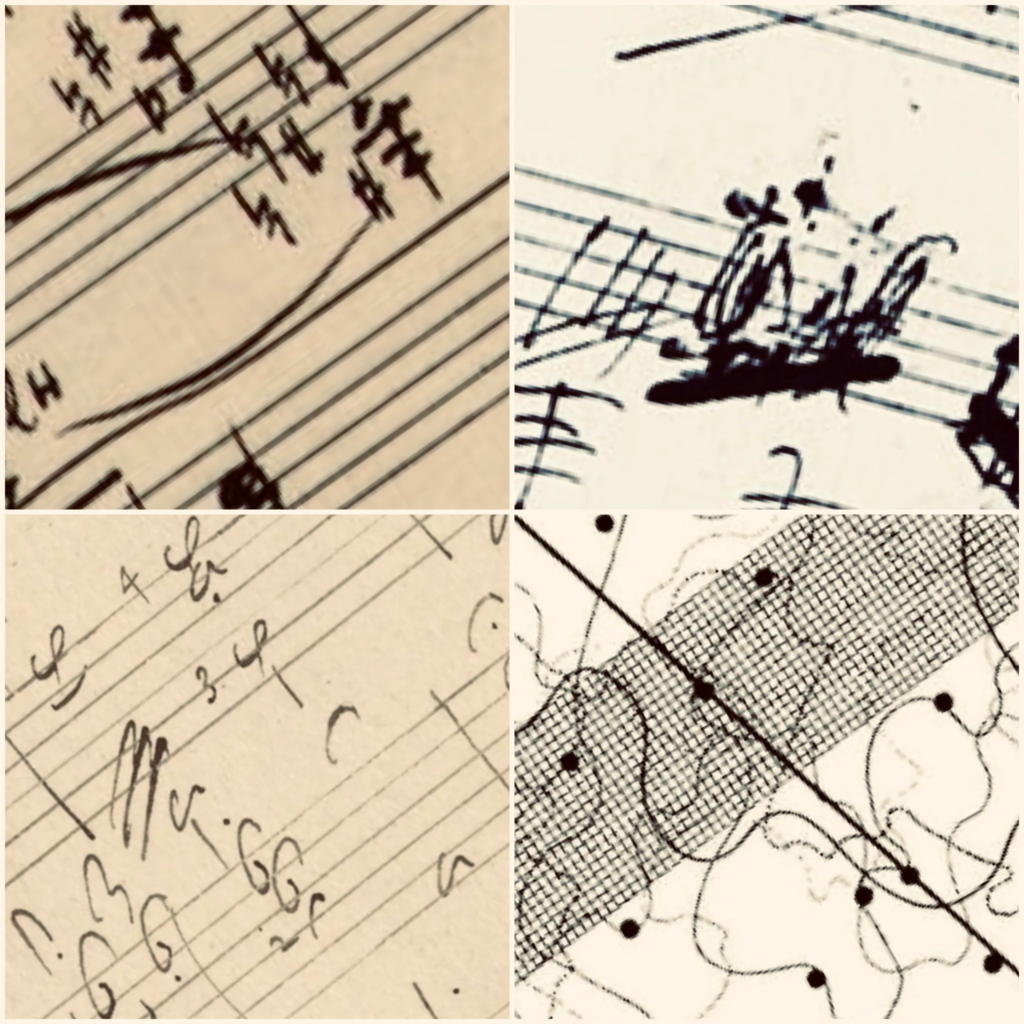
Fractured Ontologies in Music explores musical forms in which fracture becomes a productive way of organizing musical experience. From the spectral dispersions of the French style brisé to the phantomic operations of fantasia and the mutable structures of variation in the Romantic piano repertoire, music emerges as a field where presence is continually refracted through absence, interruption, and excess. Across these perspectives, the seminar asks how musical forms might resist organic wholeness without simply celebrating its dissolution, opening instead onto modes of existence that are multiple, unstable, and generative.
Session I (“Style Brisé’s Ghost: Neither Unity Nor Its Loss,” with Carlos A. Segovia and a guest contribution by Luigi Attademo) explores how French Baroque music—and the lute world within it in particular—is an anomaly running perpendicular to the principles of development of modern European music. Neither is architecture in it prior to expression, as in Renaissance polyphony, nor does drama determine form, as in the Italian Baroque—the development of these tendencies having resulted in Classicism and Romanticism, and post-Romanticism having dissolved organic wholeness wherever it emerged. The French style brisé or luthé—which is not merely a style but an aesthetic field with its own affective ontology—thus amounts to modernity’s musical ghost. Two ideas define it: the refraction and diffraction of the experienceable. Through them, harmony and rhythm, to which melody is subordinated, disperse into echoes, delays, and interruptions, from the repertoire to the individual note. Music thus becomes spectral: neither does unity precede fragmentation, nor is fragmentation the effect of its loss; rather, fracture itself becomes the condition of its manifestation. Hence, the French style brisé inhabited positively what modernism would seek through negation, thereby unsettling the narrative of today’s dominant musical aesthetics.
In turn, Session II (“Fantasia: The Sounding of a Phantom,” with Gorica Orsholits) examines fantasia: an imagined musical composition that represents the free-form, improvisational, and irrational power of imagination through sound, overcoming the limits of ordinary conceptual thinking. The structure of fantasia is a bridge between the sensory and the supersensory, where music does not imitate the external world, but directly expresses the inner essence and movement of consciousness, ignoring common harmonic structures to achieve hyper-sensual experiences. Fantasia operates through phantasm which represents a phantomic sound operation that exposes the visibility of its being through a disguise, a phantom, a non-being. The phantomic event of non-being is a combination of real and completely invented situations where the trace of a presence appears as an absence. The original fantasias were compositions intended for the lute and related string instruments, and later for keyboard instruments. In Baroque music, fantasia acquires a more extensive, technically complex structure while in the classical period, it appears in more freely-formed sonata movements. In the Romantic period, it is encountered as the title of various compositions. Fantasia in contemporary music changes shape and embodies musical expressionist melodrama, speech-songs and forms of dark, phantasmagoric musical fantasias.
Lastly, Session III (“The Mutant Sound Object: Paganini-Liszt & Variation,” with Andrea F. de Donato and a guest contribution by Gaia Ferrantini) focuses on the problem of variation. After providing an introductory overview of how the concept of variation can be defined differently in philosophy and musicology, the session presents a case study of Franz Liszt’s Grandes études de Paganini, S. 141, from 1851. This work serves as an exemplary case to demonstrate how creative thought and the structuring of a musical style can constitute multiple levels of ontological expressibility. Thus the session begins with a comparative analysis of the 1851 études and an earlier version, published by Liszt in 1838 under the title Études d’exécution transcendante d’après Paganini, S. 140. Next, focusing on Étude No. 3, “La Campanella,” four different modes of variation are identified: functional, semantic, sound, and spatial variation. Supported by specific audio and score excerpts, key harmonic characteristics are analyzed, providing the following conclusions: 1. the four modes of variation structure a distinctive sound object—not monadic and isolated, but processual and mutant; 2. from this sound object, an ontology based on variation may be derived. Whether and how this variational ontology, derived from the Paganini-Liszt études, might constitute a fractured ontology is likewise examined.
Source: https://inciteseminars.com/fractured-ontologies-in-music/